


Today, a casual search online for information about the first Catholic priests assigned to the LaSalle Mission in Illinois will result in the names Father John Blasius Raho and Aloysius John Parodi. Artificial Intelligence (AI) will also confidently state, as it is known to do, the priests were Rev. John Blasius Raho and Rev. Aloysius John Mary Parodi.
However, a closer examination suggests these search results are not correct. Rather, more extensive research indicates that the priest who served the LaSalle Mission should be identified as Father Joseph Blasius Raho.
Father Raho was an important figure in the establishment of the Catholic Church in Illinois, particularly in the Illinois Valley. There has been much written about him over the years. How could his first name be lost and replaced with John?
Propagating Errors in the Historical Record
Online search engines and generative AI systems frequently reproduce information that appears repeatedly in digitized books, websites, and other widely available sources. When an error has been repeated by seemingly authoritative publications, an AI system may present it confidently without revealing the underlying conflict in the evidence.
Looking back at where the error appears to have entered the published record, one of the first references found online referring to Father Raho as John is in the Diamond Jubilee Book published by the archdiocese of Chicago in 1920. The book uses the name at least five times. This reference was then cited that same year in an article in the Illinois Catholic Historical Review referring to Father Raho as John.
Then, in 1980, a Vincentian scholar, John E. Rybolt, C.M., wrote an article identifying Father Raho as John in the following footnote:
Giovanni Biagio (John Blaise/Blas) Raho. Born Ruffano, Italy, November 28, 1806; died Los Angeles, Calif., December 11, 1862, entry no. 30, in “Vow Book,” CMA.
More locally, Story of the LaSalle Mission is often cited as an authoritative source for information about the LaSalle Mission. It should be noted, this book, published in two parts in about 1908, appears to leave out any references to Father Raho’s first name.
However, with two sources written by authorities naming Father John Blasius Raho—the Archdiocese of Chicago’s jubilee history and the work of Rybolt, a Vincentian scholar—it is understandable other, more modern scholarly works followed their example and referred to Father Raho as John.
When the LaSalle Centennial Committee researched Father Raho, they concluded his first name was John, referring to him as Father John Blasius Raho. This was continued in St. Patrick’s history book published in 1988. Elizabeth Cummings, the author of the 1988 book, was a local historian and scholar who, like Rybolt, cited her references. In this book, she noted her reliance on the Vincentian materials.
Eileen M. McMahon refers to Father Raho as John in her article “Canal Diggers, Church Builders: Dispelling Stereotypes of the Irish on the Illinois & Michigan Canal Corridor.” This was published in the Journal of the Illinois State Historical Society and is available through JSTOR. McMahon cited Cummings’ book for information about Raho.
Among the published histories initially examined, only two referred to Father Raho as Joseph:
- Diocesan diamond jubilee, published by the Springfield Diocese in 1928, and
- Drown’s record, and historical view of Peoria, published in 1850.
All the above publications referencing Father Raho as John were written by esteemed scholars and researchers. Most of these researchers worked before the widespread digitization of historical records. They relied upon the materials available to them and had little reason to question seemingly authoritative Catholic and Vincentian sources.
Another possible challenge was that Father Raho appears to have used his middle name—variously recorded as Blase, Blasius, or Biagio—at various points in his career. Perhaps this made it more difficult for those in the twentieth century to find a definitive use of his first name in available documents.
Correcting the Record
So why question Father Raho’s name now?
The question about his name arose not from a discovery of the two sources noted above using his given name of Joseph. Rather it was the research of deeds for land purchased in the 1840s by Father Raho in LaSalle County.
In the 1840s, Father Raho bought several parcels of land in and north of the city of LaSalle. One of these was the land for the LaSalle Mission cemetery. In all these deeds, his name is shown as Joseph B. Raho. As none refer to him as “Father” or “Reverend,” and most of the modern accounts found during an initial, online search referred to him as John, research was first done to ensure he did not have a brother in the area named Joseph who bought the land. This was cleared up by an affidavit filed in the county in 1884 which may have been prepared to clarify chain of title for the land.
Father Guedry stated in a sworn affidavit that he “was personally acquainted with Joseph B. Raho the grantor in a deed…” He goes on in his testimony to name the deeds for land purchased by Joseph B. Raho and says “Raho, Penco, and O’Rielly were Catholic priests belonging to the same order of the ‘Congregation of the Mission.’” This affidavit established the Joseph B. Raho who purchased the land in earlier deeds in the 1840s was Father Raho, the Catholic priest who served the early Mission.
With several deeds documenting the first name of Joseph, the citation by Rybolt was again reviewed. Fortunately for future generations, as a trained historian and researcher often does, Rybolt included the citation to support his information about Father Raho. Rybolt indicates the “Vow Book” gives the name “Giovanni Biagio Raho.”
However, Rybolt’s footnote does not make clear whether “Giovanni Biagio” is a literal transcription of the Vow Book or Rybolt’s interpretation of an abbreviated or Latinized entry. One possibility worth investigating is whether an abbreviation for Giuseppe was misread as one for Giovanni. The original Vow Book entry would need to be examined before that possibility could be confirmed.
Additional research was then done to see if other documents not typically found online showed Father Raho’s name as Joseph. These are noted below:
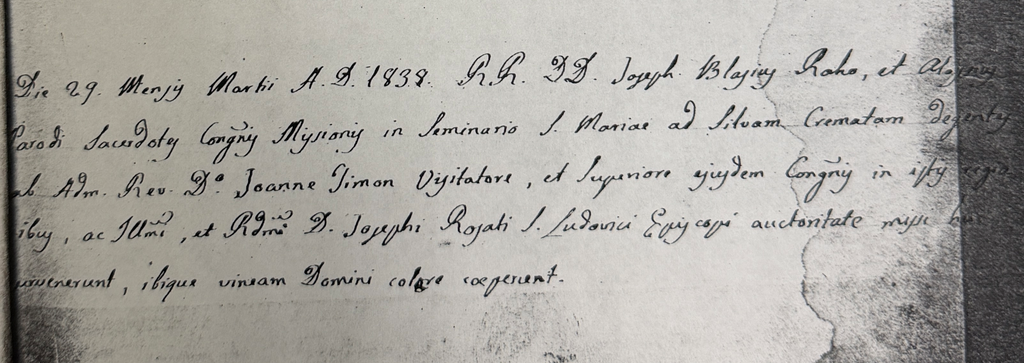
- LaSalle Mission baptismal register: On the title page of the Liber Baptizatorum, Missionis Peru LaSalle Co. in Statu Illinois in America Septentrionali, Dioecesis St. Ludovici, A.D. 1838–1848, the two priests are identified as “Joseph Blasius Raho et Aloysius Parodi.”
- The Naturalization Index: The surviving index identifies Father Raho as Joseph B. Raho and reports that he filed his “first papers” in Perry County, Missouri, on 5 August 1835.
- An article about the opening of a Catholic Church in Ottawa published in 1841 in the Free Trader in Ottawa names him Blasius Joseph Raho.
- A listing in the History of LaSalle County, published in 1886, about the establishment of the Catholic Church in Ottawa names him as Father Blasius Joseph Raho.
- Marriage records from Perry County, Missouri, identify Joseph B. Raho as the pastor of St. Mary’s Congregation who performed the marriage ceremonies.
- The 1840 federal census for LaSalle County names Joseph B. Raho as a head of household immediately adjacent to Lewis Parodi.
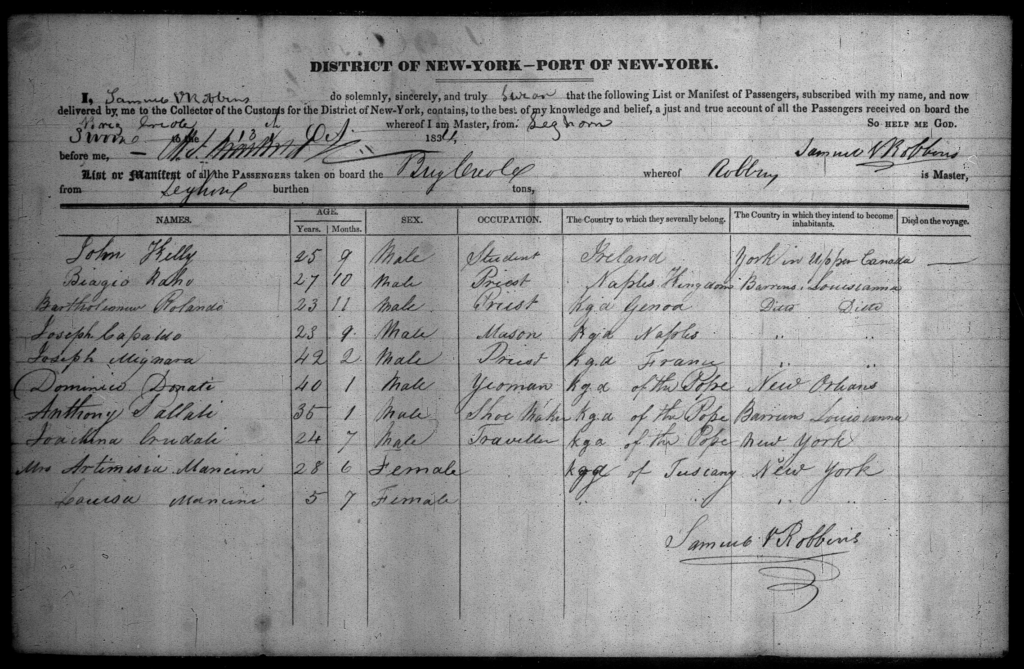
- Father Raho is listed on a ship manifest from 1834 for his arrival in New York from Italy. This record shows his name as Biagio Raho and notes he is a priest. The manifest also gives his destination as “Barrens, Louisiana,” evidently referring to the Catholic seminary at the Barrens in present-day Perryville, Missouri.
This research is not exhaustive. Another good source to check would be Father Raho’s baptism record. However, it is most likely held by a Catholic church in Italy, and the relevant records from his presumed place of birth do not appear to be available online.
Most significantly, of the sources above, the title page of the LaSalle Mission’s own baptismal register for 1838–1848 identifies the two missionaries as “Joseph Blasius Raho et Aloysius Parodi.” This early ecclesiastical record gives Raho’s complete name, while the deeds, naturalization index, census, marriage records, newspaper accounts, and sworn affidavit independently identify him as Joseph B. Raho.
Taken together, the evidence strongly supports correcting his name in accounts of the LaSalle Mission to Father Joseph Blasius Raho.
A Tale of Caution
Preserving local history is a collaborative, ongoing effort. Generations of dedicated local historians, volunteers, and regional authors have spent countless hours combing through old records to build the foundations of what we know about early LaSalle County.
As we uncover conflicting evidence, it is important to document and discuss these findings. Sometimes the established account must be corrected; sometimes it is reinforced; and sometimes the evidence remains inconclusive. As historians, we must remain open to new evidence, weigh it against established knowledge, and revise our conclusions when the evidence warrants revision.
Historical societies have an obligation to research, cite their work, and publish findings to maintain as accurate an account of history as is possible. This becomes even more critical as AI reaches into that work, pulls out “facts,” and presents them as if they are undisputed truth. Repeatedly sharing undocumented historical claims online, particularly as a historical society, can reinforce errors that search engines and AI systems may later present confidently as fact.
We are also leaving a legacy for future generations who may find additional records. Because we cite our sources, they will be able to weigh new evidence against what has already been found and used to support published history. Then they can either correct or make use of past work.
Therefore, the Society recognizes that the conclusions presented in this article may one day require revision if someone locates Father Raho’s original baptismal record, the original Vow Book entry, or another record not yet discovered.
A special thank you goes to Rachael Mellen of the LaSalle County Genealogy Guild. When I told her about the conflicting evidence concerning Father Raho’s name, she immediately said we needed to look at the St. Patrick’s Church baptism book. She was right. The title page of the original LaSalle Mission baptismal register identifies him as Joseph Blasius Raho, providing the clearest evidence found during this research. It was a wonderful example of how collaboration among local researchers can help us recover a more accurate understanding of our history.
Sources:
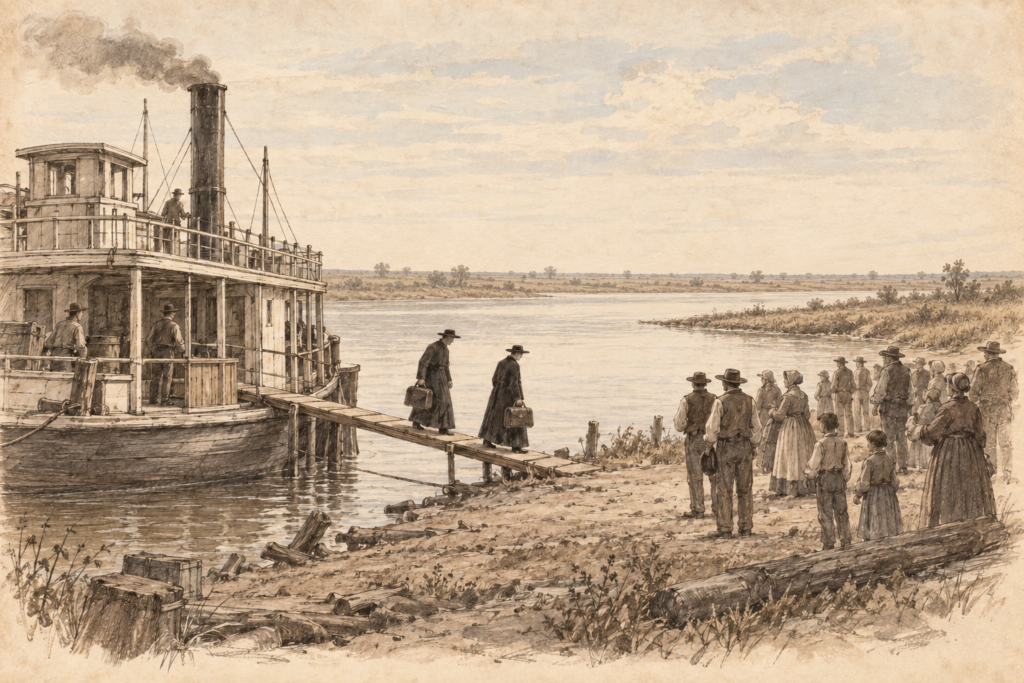
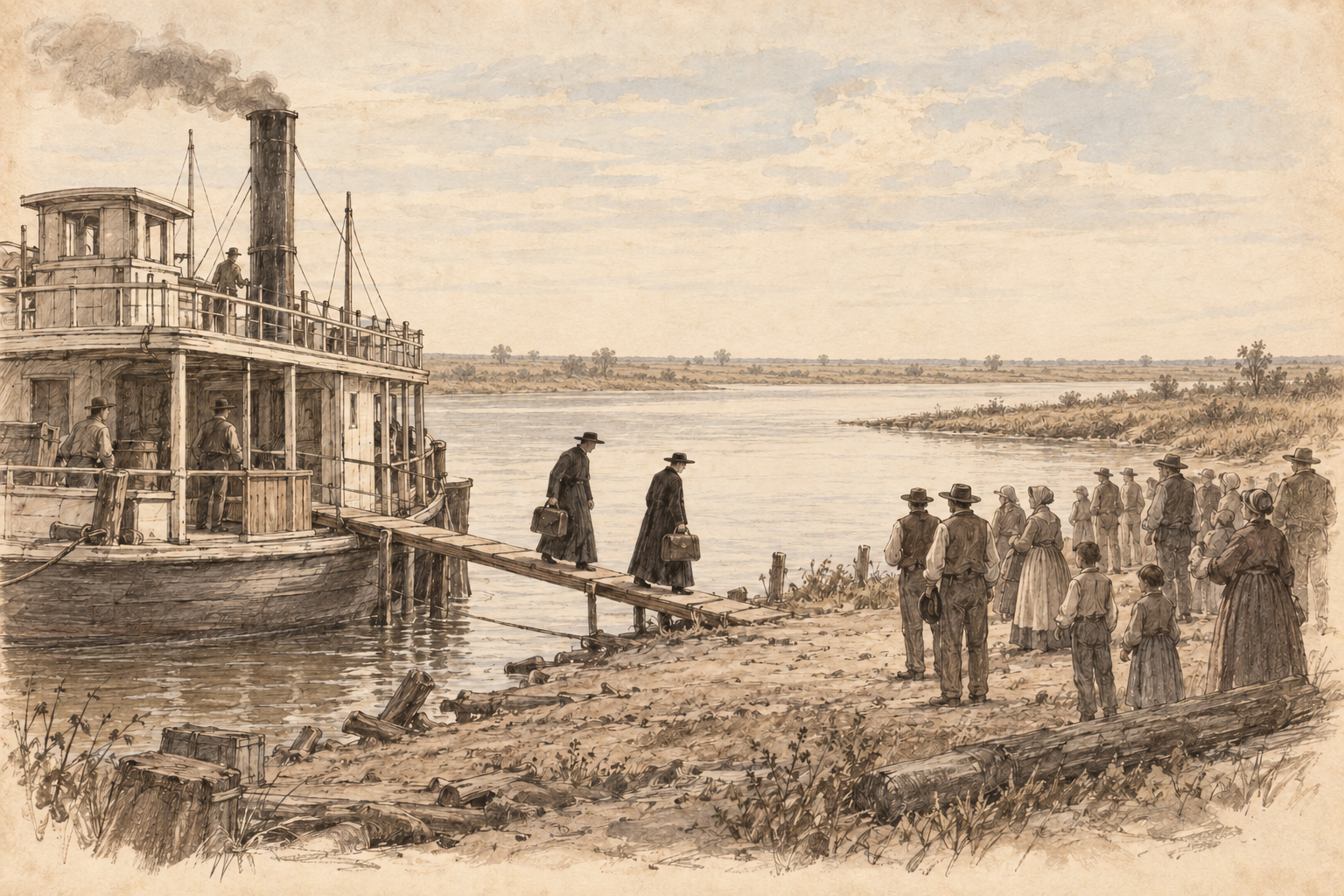
The featured image is an AI generated representation by ChatGPT of the arrival of the priests for the LaSalle Mission.
LaSalle, (Ill.) Centennial Committee, La Salle, Illinois : an historical sketch, p. 24, La Salle, Illinois : La Salle Centennial Committee, 1952, digital book, Hathi Trust (https://hdl.handle.net/2027/uiuo.ark:/13960/t9765j28s : accessed 9 October 2026). Text: “..Father John Blasius Raho…”
Elizabeth Cummings, The Stone Church, The Story of St. Patrick’s in LaSalle, 1838–1988, p. 10, book, New York: Custombook, 1988. Text: “..Rev. John Blasius Raho..”
Thomas A. Shaw, Story of the LaSalle Mission, Part 1, Chicago : M.A. Donohue, 1908?, digital book, Internet Archive (https://archive.org/details/storyoflasallemi01shaw : accessed 9 October 2026). A search of the digital version of this book resulted in no mention of Father Raho’s first name.
Thomas A. Shaw, Story of the LaSalle Mission, Part 2, Chicago : M.A. Donohue, 1908?, digital book, Internet Archive (https://archive.org/details/storyoflasallemi02shaw/page/112/mode/2up : accessed 9 October 2026). A search of the digital version of this book resulted in no mention of Father Raho’s first name.
Illinois Catholic Historical Society, Illinois Catholic Historical Review, July 1920, Vol. III, No. 1, “The Double Jubilee,” p. 8, Chicago: Illinois Catholic Historical Society, 1920, digital book, Internet Archive (https://dn721801.ca.archive.org/0/items/midamerica03illiuoft/midamerica03illiuoft.pdf : accessed 9 October 2026). Text: “Father John Blasius Raho, C. M. established the Church in LaSalle and Ottawa, and made a wide circuit of several counties.” Cites the next source for this information.
The archdiocese of Chicago, antecedents and development, Diamond Jubilee Book, pp. 130, 171, 179, 189 and 285, Des Plaines, Ill.: St. Mary’s Training School Press, 1920, digital book, FamilySearch (https://www.familysearch.org/library/books/viewer/346441/ : accessed 9 October 2026). Text: “Father John Blasius Raho, C.M., of LaSalle,” “…Rev. John Blasius Raho, C.M.” and “…Reverend John Blasius Raho, C.M.” No citations could be found in this book.
Catholic Church. Diocese Of Springfield, Ill, Diocesan diamond jubilee, 1853-1928, and cathedral dedication, Oct. 14, 15, 16, 1928, p. 22, Quincy, Ill.: Jost & Kiefer Printing Co, 1928, digital book, Internet Archive (https://archive.org/details/diocesandiamondj00cath : accessed 9 October 2026). Text: “…Fathers Joseph B. Raho,…” No citations could be found in this book.
Simon De Witt Drown, Drown’s record, and historical view of Peoria : from the discovery by the French Jesuit Missionaries, in the seventeenth century, to the present time ; also, an almanac for 1851 ; to which is added a business directory of the city with business cards, p. 164, Peoria, Ill.: E.O. Woodcock, 1850, digital book, Internet Archive (https://archive.org/details/drownsrecordhist00indrow : accessed 9 October 2026). Text: “…by the Rev. Joseph B. Raho.”
Eileen M. McMahon, “Canal Diggers, Church Builders: Dispelling Stereotypes of the Irish on the Illinois & Michigan Canal Corridor.” Journal of the Illinois State Historical Society (1998-), vol. 111, no. 4, 2018, pp. 43–81. JSTOR, (https://doi.org/10.5406/jillistathistsoc.111.4.0043 : accessed 1 October 2026.) Text: “…Father John Blasius Raho…”
John E. Rybolt, “The Carondelet Seminary,” Missouri Historical Review, 1980, p. 394.
Betty Ann McNeil D.C., “The work is never finished…” A Tribute to John Earl Rybolt, C.M.,” Vincentian Studies, Volume 39, Issue 1, 12-1-2025, DePaul University (https://via.library.depaul.edu/cgi/viewcontent.cgi?article=1662&context=vhj : accessed 9 October 2026). According to this source, “Rybolt was a founding member of the Vincentian Studies Institute and has been actively involved in the Institute throughout its history (1979-Present), serving as Secretary-Treasurer, 1979-1982, and Presiding Officer, 1982-1991.”
1840 U.S. census, LaSalle County, Illinois, LaSalle, page 131 (stamped), line 6, for Joseph B. Raho; imaged, “1840 United States Federal Census,” Ancestry (https://www.ancestry.com/imageviewer/collections/8057/images/4411226_00265 : accessed 9 October 2026).
“Illinois, U.S., Federal Naturalization Records, 1856-1991,” Joseph B. Raho, imaged, Ancestry (https://www.ancestry.com/imageviewer/collections/61196/images/004641212_02258 : accessed 9 October 2026).
History of LaSalle County, Illinois, Vol. 1, p. 497, Chicago: Inter-state Publishing Co., 1886.
Liber Baptizatorum, Missionis Peru LaSalle Co. in Statu Illinois in America Septentrionali, Dioecesis St. Ludovici, A.D. 1838–1848, St. Patrick’s Church, Title Page. Copy viewed at the LaSalle County Genealogy Guild, Ottawa, Illinois.
Other references are listed in the attached document.
Leave a Reply